Safia Nur Ahmed , a member of the Rotary Club of Etobicoke, recalls desperate lack of women’s services during month-long stint in her homeland.

Seven months ago, on her first day volunteering at a pediatric hospital in Mogadishu, Toronto Public Health nurse Safia Nur Ahmed observed a woman moaning and lying on the ground under a tree, apparently left alone to die.
Instinctively, Ahmed went to the woman. “I touch her hand and she grabs my hand and puts it on her chest and squeezes it,” she says. Ahmed began massaging her chest. The woman, whom Ahmed would later learn had survived drought and the death of her eight-year-old son, stopped moaning and fell asleep.
“I sat there weeping. I’m still weeping,” Ahmed says of the incident and of what happened next. “All the other nurses came over and began to help massaging her,” she says. “It was as if they were waiting for permission.” ...
This simple but comforting act might not seem significant but, in Somalia, nursing is not a respected profession, says Ahmed, who was born in the southern part of the country but left in 1983 to study accounting in India. Families provide personal care to patients; nurses only perform basic medical tasks.
“I really see that woman as the country – dying. But when there’s something good, everyone wants to participate when they see the results,” she says.
It wasn’t until Ahmed came to Canada that she encountered the nurturing side of nursing.
Ahmed was nine months pregnant in 1991 when she moved to Sudbury with her husband and two-year-old son. As she adjusted to the shock of a new culture and freezing temperatures in Canada, famine and social unrest loomed in her home country as warring militias fought to gain control. Her younger sister, who suffered from epilepsy, and an orphaned, diabetic child who was under her mother’s care died because of a lack of medication.
Ahmed remembers holding her newborn son while watching a news report about Baidoa, a market town approximately 250 kilometres northwest of the capital Mogadishu, ominously referred to as “death city.” The new mother was struck by the image of an orphaned child who looked so much like her own, and became overcome by a desire to take care of him.
Ahmed, who says she will never forget the nurses who comforted her during the birth of her child, made the decision to go back to school and become one herself. She graduated from Laurentian University in 1998, and a year later began working with Ontario’s Healthy Families program, assisting new and at-risk mothers.
INMED International Healthcare Preceptor Award
This award recognizes individuals who have made an important impact in training of the next generation of international healthcare volunteers. Through their instruction and their role modeling, award recipients express the value of each individual.
Safia Ahmed
2025
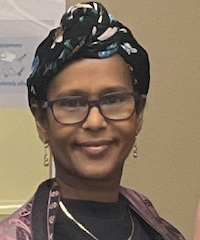 Safia Ahmed is a public health nurse with over 20 years of experience leading and delivering health services to refugees, newcomer immigrants, and residents in low-income neighborhoods in Toronto.
Her particular emphasis has been on strengthening health systems, especially those aimed at maternal and child health with attention to breast-feeding and infant nutrition.
In 2023 she earned the INMED Graduate Certificate in International Nursing and Public Health, as well as professional qualifications in Helping Babies Breathe, Helping Mothers Survive, and Essential Care for Every Newborn.
Since that time, Safia Ahmed has continued to actively teach these subjects in Kenya, Ethiopia, and Somalia, as well as here at the Humanitarian Health Conference pre-conference courses. Safia states, "Through INMED, I have gained a wealth of knowledge and added many new tools to my toolbox. More than the courses, I have found a supportive family of like-minded individuals at INMED. The community and the quality of education have been truly exceptional."